Company News
The insulating joint (or isolating joints or isolation joints) is a new generation developed product to resolve use problems of old insulating flange. It is the essential pressure component necessary ...
Although the stainless steel pipe is a hard-to-cut metal material, the material is not very strong, and it is also sticky. The main cutting chips are also easy to stick to the tool, so it is classifie...
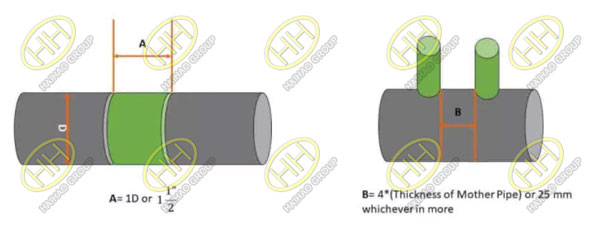
American code and standard mandate the minimum distance between two welds in a pipeline.But most company specification will give some minimum distance that you have to maintain between two nearby weld...
EN 10255 Grade S195T Carbon Steel Seamless Tubes are also known as mild steel pipes and tubes.EN 10255 Grade S195T Tubes are low-cost Low Carbon Steel Tubes with max 020 % carbon content with combinat...
SUS304 refers to 304 stainless steel. SUS is the Japanese material standard, so what’s its heat treatment method? Solution treatment: Its purpose is to make the carbide fully dissolved and retai...
SUS304 refers to 304 stainless steel. SUS is a Japanese material standard, 304 stainless steel is a brand of stainless steel produced according to the American ASTM standard. 304 is equivalent to the ...
Description: 304 and 303 are made of stainless steel, but the composition is different. SUS303 and SUS304 are called by Japan, while China is called y1cr18ni9 and 0Cr18Ni9 respectively. In China, inte...
The A312/A312M-02 Standard Specification for Seamless and Welded Austenitic Stainless Steel Pipes covers seamless, straight-seam welded, and heavily cold worked welded austenitic stainless steel pipe ...
Comparing US American (ASTM) and British (BSi) piping standards – specifications, grades and material descriptions. The table below compares some British (BSi) and American (ASTM) piping standar...
Prefabricated directly buried heat preservation pipe is a steel pipe which is processed by heat preservation technology and ensures that the internal temperature and surface temperature of the working...
ASME B16.5 and ASME B16.47 are two often used standards for flanges.What is the difference between them? ASME B16.5 standard covers Steel Pipe Flanges and Flanged Fittings from NPS 1/2 through NPS 24 ...
ASME B16.47 standard is mainly used for big size flange above 24″.It covers pipe flanges in sizes 26″ through 60″ and in pressure class ratings 75, 150, 300, 400, 600, and 900. Then,...
Corten steel or weathering steel is a corrosion-resistant material. When left uncoated, it forms a protective layer (platina) on the outer surface that protects this steel material from acidic environ...
NACE is recognized globally as the premier authority for corrosion control solutions.The organization offers some industry standards which contain MR0175 and NACE MR0103 . NACE MR0175 is for Petroleum...
A672 B60 pipe specification covers electric-fusion-welded steel pipe with filler metal added, fabricated from pressure vessel quality plate of several analyses and strength levels and suitable for hig...
Non-destructive testing is carried out on the piping components to ensure the soundness of the body & weld. NDT will check whether any physical subsurface defects such as crack, porosity or lack o...
ASTM standard specifies the specific manufacturing process and precise chemical composition requirements of steel pipe, pipe fitting and flange materials, including the content percentage of carbon, m...
What is 1.4541? What kind of material is it equivalent to in China? 1.4541 is the European BSEN standard number, which is equivalent to 06cr18ni11ti material in Chinese GB / t20878 standard. It’...