


Butt weld branch outlets are among the most widely used fittings for creating reinforced branch connections in piping systems. Designed in accordance with MSS SP-97, these fittings provide a reliable and efficient solution for connecting a smaller branch pipe to a larger run pipe while maintaining structural integrity.
Unlike socket weld or threaded outlets, butt weld branch outlets are welded directly to both the run pipe and the branch pipe. Their beveled ends simplify welding and ensure a smooth transition, reducing turbulence and stress concentration at the connection point.
What Is a Butt Weld Branch Outlet?
A butt weld branch outlet is a type of forged fitting used to create a 90-degree branch from a main pipe. It features:
- A contoured base that fits the curvature of the run pipe
- A beveled outlet end for butt welding to the branch pipe
- Integral reinforcement to meet pressure and strength requirements
This design eliminates the need for additional reinforcement pads, making installation faster and more reliable.
Key Advantages
1. Superior Strength and Reinforcement
The integrally reinforced structure distributes stress evenly, reducing the risk of cracking or failure under high pressure or temperature conditions.
2. Improved Flow Efficiency
The smooth internal transition minimizes flow disruption and pressure loss, which is critical in high-performance systems.
3. Secure and Leak-Free Connection
Butt welding creates a permanent, high-integrity joint, ideal for critical applications such as oil & gas, petrochemical, and power generation.
4. Compliance with Industry Standards
Manufactured to MSS SP-97, these fittings ensure dimensional accuracy and compatibility with international piping systems.
Standard Dimensions (STD & XS)
Below is a simplified overview of typical dimensions for butt weld branch outlets. Full data should always be verified against project specifications.
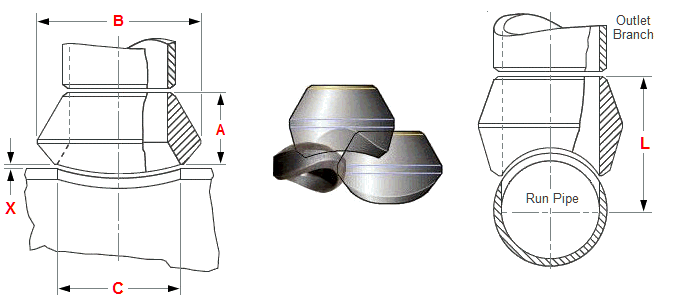
| pressure | NPS | A | B | C | D |
| STD | 1/2″ | 19.05 | 34.93 | 23.81 | 15.88 |
| STD | 3/4″ | 22.23 | 41.28 | 30.16 | 20.64 |
| STD | 1″ | 26.99 | 50.8 | 36.51 | 26.19 |
| STD | 1 1/4″ | 31.75 | 60.3 | 44.45 | 34.93 |
| STD | 1 1/2″ | 33.34 | 73 | 50.8 | 41.28 |
| STD | 2″ | 38.1 | 88.9 | 65.09 | 52.39 |
| STD | 2 1/2″ | 41.28 | 103.19 | 76.2 | 61.91 |
| STD | 3″ | 44.45 | 122.24 | 93.66 | 77.79 |
| STD | 3 1/2″ | 50.8 | 136.53 | 98.43 | 90.49 |
| STD | 4″ | 50.8 | 152.4 | 120.65 | 101.6 |
| STD | 5″ | 57.15 | 180.98 | 141.29 | 128.59 |
| STD | 6″ | 60.3 | 215.9 | 169.86 | 153.99 |
| STD | 8″ | 69.85 | 263.53 | 220.66 | 201.61 |
| STD | 10″ | 77.79 | 319.09 | 274.64 | 254 |
| STD | 12″ | 85.73 | 377.83 | 325.44 | 304.8 |
| STD | 14″ | 88.9 | 409.58 | 357.19 | 336.55 |
| STD | 16″ | 93.66 | 463.55 | 407.99 | 387.35 |
| STD | 18″ | 103.19 | 527.05 | 473.08 | 438.15 |
| STD | 20″ | 117.48 | 585.79 | 509.59 | 488.95 |
| STD | 24″ | 136.53 | 708.03 | 638.18 | 590.55 |
| XS | 1/2″ | 19.05 | 34.93 | 23.81 | 15.88 |
| XS | 3/4″ | 22.23 | 41.28 | 30.16 | 20.64 |
| XS | 1″ | 26.99 | 50.8 | 36.51 | 26.19 |
| XS | 1 1/4″ | 31.75 | 61.91 | 44.45 | 34.93 |
| XS | 1 1/2″ | 33.34 | 73 | 50.8 | 41.28 |
| XS | 2″ | 38.1 | 88.9 | 65.09 | 52.39 |
| XS | 2 1/2″ | 41.28 | 103.19 | 76.2 | 61.91 |
| XS | 3″ | 44.45 | 122.24 | 93.66 | 77.79 |
| XS | 3 1/2″ | 50.8 | 136.53 | 98.43 | 90.49 |
| XS | 4″ | 50.8 | 152.4 | 120.65 | 101.6 |
| XS | 5″ | 57.15 | 180.98 | 141.29 | 128.59 |
| XS | 6″ | 77.79 | 225.43 | 169.86 | 153.99 |
| XS | 8″ | 98.43 | 269.88 | 220.66 | 193.68 |
| XS | 10″ | 88.9 | 327.03 | 265.11 | 254 |
| XS | 12″ | 100.01 | 385.76 | 330.2 | 304.8 |
| XS | 14″ | 104.78 | 423.86 | 363.54 | 330.2 |
| XS | 16″ | 112.71 | 479.43 | 419.1 | 381 |
| XS | 18″ | 119.06 | 536.58 | 473.08 | 431.8 |
| XS | 20″ | 127 | 593.73 | 528.64 | 482.6 |
| XS | 24″ | 139.7 | 708.03 | 638.18 | 584.2 |
Materials and Manufacturing
Butt weld branch outlets are typically forged from high-quality materials such as:
- Carbon steel (e.g., ASTM A105)
- Stainless steel (e.g., ASTM A182 F304/F316)
- Duplex and super duplex stainless steels
- Alloy steels for high-temperature service
Forging ensures excellent mechanical properties, including toughness and resistance to pressure fatigue.
Typical Applications
These fittings are widely used in:
- Oil & gas transmission pipelines
- Petrochemical processing plants
- Power generation facilities
- Offshore and subsea systems
- Water treatment and industrial piping
Their ability to handle high pressure and temperature makes them suitable for critical service environments.
Installation Considerations
To achieve optimal performance:
- Ensure proper alignment with the run pipe curvature
- Use qualified welding procedures (WPS/PQR)
- Perform non-destructive testing (NDT) after installation
- Follow applicable codes such as ASME B31.3 or B31.1
Why Choose Butt Weld Branch Outlets?
For engineers and procurement professionals, butt weld branch outlets offer a balance of strength, reliability, and cost-efficiency. Their standardized design under MSS SP-97 ensures compatibility across projects, while their robust construction minimizes maintenance and downtime.
FAQ (Structured for SEO)
Q1: What is the difference between STD and XS branch outlets?
STD refers to standard wall thickness, while XS (extra strong) provides thicker walls for higher pressure applications.
Q2: Are butt weld branch outlets suitable for high-pressure systems?
Yes, their integral reinforcement makes them ideal for high-pressure and high-temperature environments.
Q3: What standards govern these fittings?
They are primarily manufactured according to MSS SP-97, ensuring consistency and reliability.
Q4: What industries commonly use these fittings?
Oil & gas, petrochemical, power generation, and heavy industrial sectors are the main users.
Butt weld branch outlets remain a preferred solution for creating strong, leak-proof branch connections in demanding piping systems. With standardized dimensions, robust materials, and proven performance, they continue to play a critical role in modern industrial infrastructure.
If you’re sourcing high-quality branch outlet fittings, selecting a reliable manufacturer with strict quality control and international certification is essential for long-term project success.