


A butt weld branch outlet is one of the most widely used solutions for creating branch connections in modern piping systems. It is welded directly onto the run pipe, with beveled ends designed to ensure smooth and efficient welding. This type of fitting is commonly used in high-pressure and high-temperature environments where strength and safety are critical.
Engineered to meet the requirements of MSS SP-97, these fittings are designed to reduce stress concentration and provide integral reinforcement at the branch connection point, eliminating the need for additional reinforcement pads in most applications.
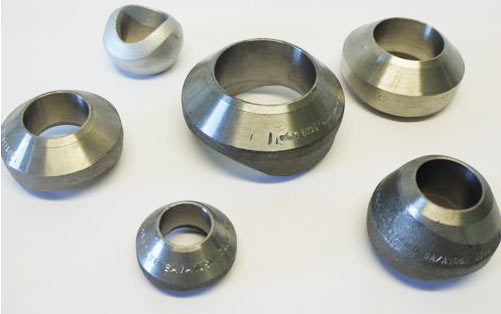
Stainless Steel Butt Welding Weldolet
What Is a Branch Connection Fitting?
A branch connection fitting is a forged piping component used to create a smaller outlet from a larger main pipe. Unlike traditional tees or lateral fittings, these fittings are designed for reinforced welded connections that match or exceed the pressure rating of the run pipe.
Each fitting is clearly marked with its outlet size and compatible pipe sizes. For example, a marking such as “5-3×3/4” indicates a 3/4-inch outlet suitable for installation on 3″, 3½”, 4″, and 5″ pipes, maintaining tight tolerances to ensure proper fit-up during welding.
For smaller sizes (typically 4 inches and below), the fitting can accommodate multiple pipe sizes, while larger dimensions are usually designed for specific pipe diameters. A flat base version is also available for installation on vessel heads and pipe caps.
Design and Functional Features
These branch fittings are engineered to form a 90-degree connection to the main pipe. They are available in both full-size and reducing configurations depending on system requirements.
A typical designation such as “10×6” indicates a 6-inch outlet installed on a 10-inch run pipe. This standardized identification system helps engineers and fabricators ensure correct selection during project execution.
Key engineering advantages include:
- Reduced stress concentration at the branch area
- Strong welded integration with the main pipe
- No requirement for additional reinforcement pads
- Improved flow transition and system reliability
Standard Dimensions Overview
The following table summarizes typical dimensions for standard and extra-strong wall thickness fittings. Values vary depending on pipe schedule and project requirements.
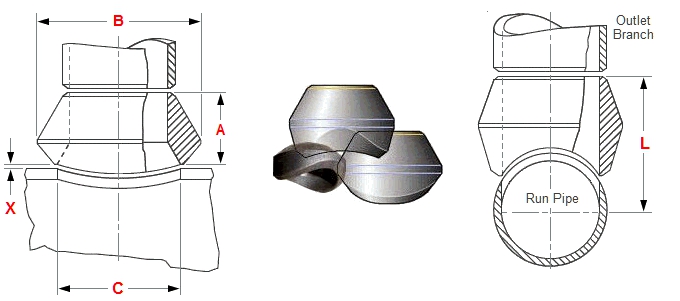
Butt Welding Weldolet Welded With Pipes
| Weldolet STD Sch Dimensions | Weldolet XS Sch Dimensions | |||||||
| NPS | A | B | C | D | A | B | C | D |
| 1/2″ | 19.05 | 34.93 | 23.81 | 15.88 | 19.05 | 34.93 | 23.81 | 15.88 |
| 3/4″ | 22.23 | 41.28 | 30.16 | 20.64 | 22.23 | 41.28 | 30.16 | 20.64 |
| 1″ | 26.99 | 50.8 | 36.51 | 26.19 | 26.99 | 50.8 | 36.51 | 26.19 |
| 1 1/4″ | 31.75 | 60.3 | 44.45 | 34.93 | 31.75 | 61.91 | 44.45 | 34.93 |
| 1 1/2″ | 33.34 | 73 | 50.8 | 41.28 | 33.34 | 73 | 50.8 | 41.28 |
| 2″ | 38.1 | 88.9 | 65.09 | 52.39 | 38.1 | 88.9 | 65.09 | 52.39 |
| 2 1/2″ | 41.28 | 103.19 | 76.2 | 61.91 | 41.28 | 103.19 | 76.2 | 61.91 |
| 3″ | 44.45 | 122.24 | 93.66 | 77.79 | 44.45 | 122.24 | 93.66 | 77.79 |
| 3 1/2″ | 50.8 | 136.53 | 98.43 | 90.49 | 50.8 | 136.53 | 98.43 | 90.49 |
| 4″ | 50.8 | 152.4 | 120.65 | 101.6 | 50.8 | 152.4 | 120.65 | 101.6 |
| 5″ | 57.15 | 180.98 | 141.29 | 128.59 | 57.15 | 180.98 | 141.29 | 128.59 |
| 6″ | 60.3 | 215.9 | 169.86 | 153.99 | 77.79 | 225.43 | 169.86 | 153.99 |
| 8″ | 69.85 | 263.53 | 220.66 | 201.61 | 98.43 | 269.88 | 220.66 | 193.68 |
| 10″ | 77.79 | 319.09 | 274.64 | 254 | 88.9 | 327.03 | 265.11 | 254 |
| 12″ | 85.73 | 377.83 | 325.44 | 304.8 | 100.01 | 385.76 | 330.2 | 304.8 |
| 14″ | 88.9 | 409.58 | 357.19 | 336.55 | 104.78 | 423.86 | 363.54 | 330.2 |
| 16″ | 93.66 | 463.55 | 407.99 | 387.35 | 112.71 | 479.43 | 419.1 | 381 |
| 18″ | 103.19 | 527.05 | 473.08 | 438.15 | 119.06 | 536.58 | 473.08 | 431.8 |
| 20″ | 117.48 | 585.79 | 509.59 | 488.95 | 127 | 593.73 | 528.64 | 482.6 |
| 24″ | 136.53 | 708.03 | 638.18 | 590.55 | 139.7 | 708.03 | 638.18 | 584.2 |
Material and Manufacturing Quality
These fittings are typically manufactured from forged carbon steel, stainless steel, and alloy materials depending on service conditions. Forging ensures excellent mechanical strength, fatigue resistance, and long-term durability in demanding industrial environments.
Strict dimensional control and inspection processes are applied to ensure compliance with international piping codes and project specifications.
Typical Applications
Branch outlet fittings are widely used in:
- Oil and gas transmission pipelines
- Petrochemical processing units
- Power generation systems
- Offshore and subsea installations
- Industrial fluid transportation networks
Their robust design makes them suitable for critical service where leakage prevention and mechanical integrity are essential.
Installation Considerations
To ensure safe and reliable performance, proper welding procedures and alignment are essential. Recommended practices include:
- Accurate fit-up between run pipe and outlet
- Qualified welding procedures (WPS/PQR)
- Post-weld inspection and NDT testing
- Compliance with ASME piping codes
Branch connection fittings designed under MSS SP-97 provide a dependable solution for modern piping systems. Their reinforced structure, ease of installation, and high-pressure capability make them a preferred choice for engineers and project designers worldwide.
For industrial projects requiring durability and precision, selecting high-quality forged fittings is essential to ensure long-term operational safety and efficiency.