


In modern pipeline engineering, branch connections are essential for distributing fluids from a main pipeline to secondary lines. Two widely used fittings for this purpose are the socket branch outlet and the welded branch outlet.
Both fittings belong to the category of branch outlet fittings and are typically manufactured according to the MSS SP-97 standard and ASME B16.11, which specifies requirements for integrally reinforced branch connections used in piping systems.
Although the two fittings perform similar functions, the socket branch outlet vs welded branch outlet comparison shows clear differences in connection method, structural strength, and industrial applications. Understanding these differences helps engineers select the appropriate fitting for oil & gas pipelines, petrochemical facilities, and power plant piping systems.

ASME B16.11 ASTM A105 welded branch outlets manufactured by Haihao Group
Materials Used for Branch Outlet Fittings
High-quality branch outlet fittings must operate safely under demanding pressure and temperature conditions. For this reason, manufacturers produce these fittings in various materials depending on project requirements.
Common materials include:
- ASTM A105 carbon steel
- ASTM A350 LF2 low-temperature carbon steel
- ASTM A182 F304 / F304L stainless steel
- ASTM A182 F316 / F316L stainless steel
- Alloy steels specified by engineering projects
The choice of material usually depends on operating conditions such as pressure rating, corrosion resistance, and pipeline temperature.
Design Differences Between Socket Branch Outlet and Welded Branch Outlet
The primary difference between these fittings lies in how they connect to the pipeline and branch pipe.
Socket Branch Outlet Design
A socket branch outlet uses a socket-weld connection. The branch pipe is inserted into the socket portion of the fitting and secured using a fillet weld.
Because of this design, the socket branch outlet is commonly used in small-diameter piping systems where installation needs to be efficient and compact.
Typical advantages include:
- Easy installation
- Compact design
- Suitable for small pipelines
- Reduced welding time
These characteristics make socket outlets widely used in utility pipelines and secondary process lines.
Welded Branch Outlet Design
A welded branch outlet uses a butt-weld connection. The branch pipe is welded directly to the beveled outlet end using a full penetration weld.
The base of the fitting is contoured to match the curvature of the main pipe, which provides additional reinforcement for the branch connection.
Compared with socket connections, the welded branch outlet offers stronger structural performance and better stress distribution, making it suitable for critical pipeline systems.
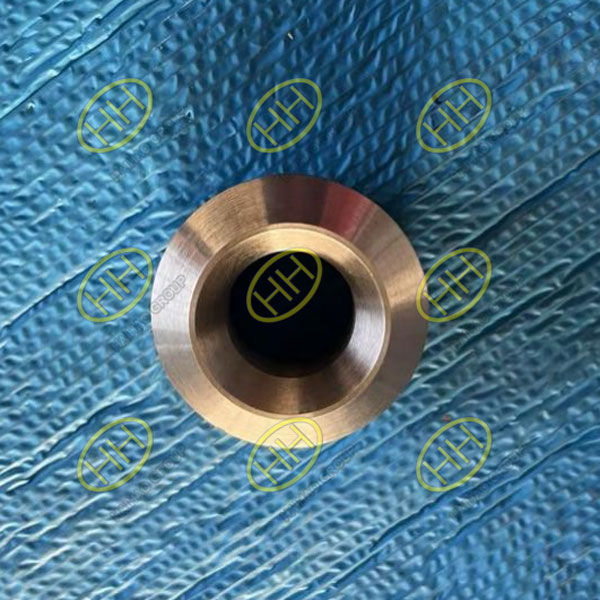
MSS SP-97 socket branch outlet Nickel Alloy ASTM B366 UNS N06625
Application Differences in Industrial Pipelines
Selecting the right branch fitting depends on several engineering factors, including pressure rating, pipe size, and service conditions.
Socket Branch Outlet Applications
A socket branch outlet is typically used in:
- Small-diameter pipelines
- Moderate pressure piping systems
- Utility and auxiliary pipelines
- Compact installation environments
These fittings are often applied in industrial plants, water systems, and mechanical service pipelines.
Welded Branch Outlet Applications
A welded branch outlet is usually preferred for more demanding environments such as:
- High-pressure pipelines
- High-temperature process systems
- Oil and gas transmission pipelines
- Petrochemical and refinery facilities
Because of its butt-weld design, the welded branch outlet provides stronger reinforcement and improved reliability in critical pipeline infrastructure.
Haihao Group Experience in Supplying Branch Outlet Fittings
As a professional manufacturer and exporter of pipeline components, Haihao Group has extensive experience supplying branch outlet fittings for international engineering projects.
The company produces both socket branch outlet and welded branch outlet fittings according to MSS SP-97, with strict quality control throughout forging, machining, inspection, and packaging processes.
Haihao Group has delivered these fittings to projects in regions including:
- Russia
- Southeast Asia
- the Middle East
- South America
Typical materials supplied include ASTM A105, A350 LF2, and A182 stainless steels, meeting the technical requirements of oil & gas, petrochemical, and energy infrastructure projects.
For example, in a recent overseas pipeline project, Haihao Group supplied a range of branch outlet fittings along with flanges and forged pipe fittings to support the construction of a high-pressure industrial pipeline system. All products were inspected according to international standards before shipment.
This project once again demonstrated Haihao Group’s capability to provide reliable branch outlet fittings for complex pipeline engineering applications.
Strength Comparison of Socket and Welded Branch Outlets
When evaluating socket branch outlet vs welded branch outlet, structural strength is an important factor.
Socket Branch Outlet Strength
A socket branch outlet relies on the strength of the socket weld and the reinforcement provided by the fitting body. When properly welded, the connection performs well under moderate pressure conditions.
Welded Branch Outlet Strength
A welded branch outlet provides stronger reinforcement because the butt-weld connection allows full penetration welding between the branch pipe and the outlet fitting.
This design improves stress distribution around the branch connection and reduces the risk of fatigue failure in high-pressure systems.
Choosing the Right Branch Outlet Fitting
Both fittings play an important role in modern pipeline systems.
- A socket branch outlet is suitable for small pipelines and moderate service conditions.
- A welded branch outlet is the preferred solution for high-pressure and high-temperature applications.
Selecting the correct branch outlet fittings helps ensure long-term pipeline safety and reliable operation.
FAQ – Socket Branch Outlet vs Welded Branch Outlet
What is a socket branch outlet used for?
A socket branch outlet is used to create a branch connection in small-diameter piping systems using a socket weld connection.
When should a welded branch outlet be used?
A welded branch outlet is recommended for high-pressure and high-temperature pipelines where a stronger butt-weld connection is required.
What standard covers branch outlet fittings?
Most branch outlet fittings are manufactured according to MSS SP-97, which specifies requirements for integrally reinforced outlet fittings used in piping systems.